The Invisible Shelf: Winning the Shift to Agentic Commerce
The Walmart-Gemini era has moved retail from Search to the Invisible Shelf. Learn how Agentic Commerce is compressing the consumer journey and why CPG leaders must shift from fighting for human clicks to fighting for Data Precedence within the AI agent’s decision-making engine.


Executive Summary: Winning the Invisible Shelf
The Challenge: The Walmart-Google Gemini partnership, announced in January 2026, marks the end of the "Search & Browse" era. We have entered the age of Agentic Commerce, where the primary gatekeeper of the consumer’s wallet is no longer a storefront, but an AI agent. For CPG brands, this creates a crisis of visibility: the transition from a "Visible Shelf" of app grids to an "Invisible Shelf" of conversational recommendations.
The Core Shift: We are transitioning from a world of Keyword Search to a world of Intent Briefs.
- Agent Precedence: AI agents now have the authority to link accounts (Walmart+), analyze purchase history, and execute "Zero-Click" checkouts within a single interface.
- The Fragmented Ecosystem: Brands no longer face a binary choice between "Retailer" and "Direct." They must now navigate a three-way battle between Retailer Agents (loyalty/retention), Consumer Agents (mercenaries of value), and Merchant Agents (brand sovereignty).
The Economic Impact: The "High-Margin Data Loop" created by these partnerships forces a radical re-evaluation of commercial spend:
- GEO vs. SEO: Traditional search spend is being cannibalized by Generative Engine Optimization (GEO).
- The Attribution Tax: Retailers are offering "Perfect Attribution" through account linking but demanding higher premiums, effectively threatening traditional trade and media margins.
Bottom Line: We are entering the era of Compressed Commerce. In a world of agentic intent, the traditional consumer journey—discovery, research, and evaluation—now happens within the AI logic before a user ever reaches a retail site. The journey effectively ends before it begins. To win, CPG leaders must shift from fighting for human clicks to fighting for Data Precedence within the agent’s decision-making engine.
READ FULL ARTICLE BELOW
I. The Shift: From Discovery Search to Agentic Commerce
The Walmart-Google partnership signals the end of the "Search & Browse" era. With the integration of Gemini into the Walmart ecosystem, we are entering Agentic Mode. Consumers no longer navigate a digital storefront; they provide an Intent Brief (e.g., "Help me plan a sustainable camping trip for four"). In this model, the interface is no longer a screen full of tiles—it is a conversation.
The transition from traditional web or app search to agent-led commerce represents the next great evolution in retail. We aren't just watching the shift, we are driving it. -John Furner, CEO of Walmart US
The New Rules of Engagement:
- The Account Link Advantage: By tethering Walmart/Sam's Club accounts directly to Gemini, the agent moves beyond traditional search—it analyzes past purchase history, subscription cycles, and real-time inventory to curate a high-conversion cart.
- Zero-Click Execution: The traditional digital storefront has been bypassed. Agents now have the authority to build carts and execute instant checkouts within the chat interface. For the brand, the iconic Add to Cart button has been replaced by Agent Precedence.
- The Invisible Shelf: We have shifted from competing for Page 1 visibility to focusing on LLM Ingestion. If your product data—from sustainability certifications to micro-usage details—is not structured for an AI agent to process, your brand does not exist in this ecosystem.
- The Universal Commerce Protocol (UCP): This serves as the Standardized Operating Layer for modern retail. With Walmart and Shopify adopting open standards, agents now interface directly with inventory systems in real-time. In the agentic world, a stockout is no longer just a missed transaction; it is a systemic disqualifier that trains the agent to prioritize your competitor in all future cycles.
II. Impact to Spend: The High-Margin Data Loop
The Walmart-Google partnership establishes a closed-loop data ecosystem that demands a strategic realignment of Walmart Connect allocations. Because the agentic shelf is conversational, traditional keyword bidding has reached a point of diminishing returns. This marks the definitive transition to the High-Margin Data Loop.
The Strategic Shift in Allocation:
From SEO to GEO (Generative Engine Optimization): Traditional search spend is becoming secondary. Brands must now shift funds toward Generative Engine Optimization. This isn’t about bidding on a single category like cereal; it’s about funding the intelligence feeds that ensure Gemini recommends your brand for complex intent—such as a request for a heart-healthy breakfast that children will actually eat.
The Premium of Precision Attribution: Because account linking tracks the entire journey from the initial AI prompt to the final doorstep delivery, retailers now offer closed-loop attribution. However, this transparency comes at a signifcant cost. Expect retailers to demand higher premiums for this level of certainty, potentially cannibalizing the trade funds previously allocated for physical price reductions.
Cannibalization of Traditional Discovery: As AI begins to curate the shopping experience, legacy retail media is losing its efficacy. Data from Salesforce indicates that AI-influenced revenue now accounts for one-fifth of total digital commerce. In this environment, failing to pivot toward agentic commerce means continuing to invest in a ghost shelf. You are paying for presence in a search result that the modern consumer has already bypassed.
Agentic Advertising Assistants: Tools like Walmart’s Marty assistant are transforming the role of the CPG professional. The Account Manager of 2026 is no longer just managing a spreadsheet; they are becoming Prompt Engineers of their own media budget—optimizing campaigns in real-time to align with the agent’s recommendation logic.
III. The Rise of Third-Party Complexity: The Fragmented Agent Ecosystem
The Walmart-Google announcement is the first shot in a much larger war. For the CPG leader, the challenge is no longer just navigating the relationship with a human merchant. We are entering a fragmented marketplace where three distinct classes of AI agents compete for decision-making power—each with a unique set of priorities and loyalty metrics.
1. Retailer Agents: The Gatekeepers of Retention
- Examples: Walmart Sparky (powered by Gemini), Amazon Rufus.
- The Objective: These agents are programmed for ecosystem containment. They prioritize the retailer’s own high-margin private labels, retail readiness metrics (OTIF, in-stock rates), and the brands that have invested most heavily in the retailer’s specific media network.
- Impact on Brand: If you aren't retail-ready, the agent will silently swap your product for a competitor or a private label before the consumer even sees the options.
2. Consumer Agents: The Mercenaries of Value
- Examples: Perplexity, ChatGPT (with Instant Checkout), Buy for Me assistants.
- The Objective: These agents serve the Shopper’s Brief. They are agnostic to retailer loyalty. They scan the entire web to find the lowest price, the fastest shipping, or the cleanest ingredients. They will actively bypass a retailer’s sponsored prompt if it doesn't align with the consumer's specific lifestyle intent.
- Impact on Brand: Winning here requires that your brand must be ingestible by LLMs as the superior choice based on objective data, not just ad spend.
3. Merchant Agents: The Defenders of Sovereignty
- Examples: Shopify Sidekick, Salesforce Agentforce, Brand-owned GPTs.
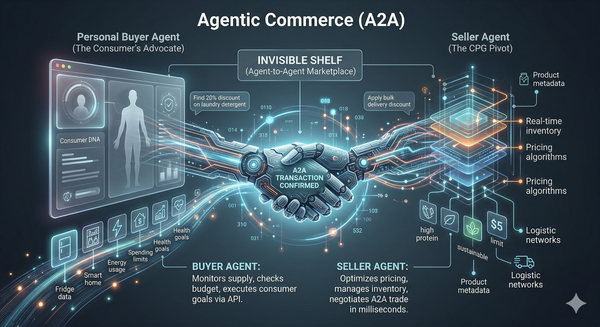
- The Objective: These agents work for the brand. Their goal is to initiate a Merchant Agent that can talk directly to a Consumer Agent to offer a one-to-one dynamic discount or a loyalty perk to close a deal directly on the brand’s site, bypassing retailer fees and the retailer tax entirely.
- Impact on Brand: This is the path to brand sovereignty. It allows the manufacturer to own the customer data and the merchant of record relationship.
V. Strategic Recommendation: The Blueprint for Agentic Readiness
To win the Invisible Shelf, CPG leaders must stop viewing AI as a tech project and start viewing it as core Commercial Infrastructure. We recommend a three-pillar strategy designed to move brands from being searchable to being selectable by autonomous agents.
1. Treat Product Metadata as Digital Labeling
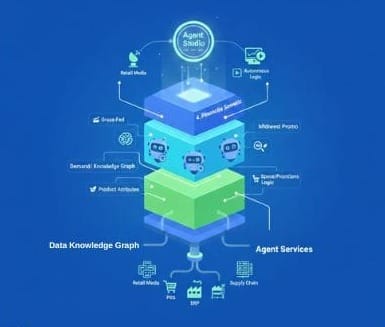
In agentic commerce, your data is your product. On a physical shelf, a shopper sees your brand logo; in Gemini, the agent sees your Product Schema.
- The Forensic Audit: Brands must ensure every attribute—from ingredient transparency and sustainability certifications to micro-usage cases (e.g., safe for high-altitude baking)—is forensic-level accurate and structured for LLM ingestion.
- The Goal: If the agent cannot verify your claim via structured data, your brand story is just noise. Data integrity is the new brand equity.
2. Pivot from SEO to GEO (Generative Engine Optimization)
The goal is no longer to rank for a keyword; it is to be the Source of Truth for the agent’s response.
- Feeding the LLM: CPGs must move beyond traditional keyword stuffing and focus on creating "Answer Packets"—verified, machine-readable data feeds that explain the Reason to Believe (RTB) behind a product.
- The Goal: When Gemini plans a "sustainable camping trip", your brand must be the only logical, data-backed recommendation for the agent to cite.
3. Build the Agent-to-Agent (A2A) Bridge
Relying solely on a retailer’s internal agent (like Walmart Sparky) is a recipe for margin erosion. CPGs must own the relationship with the consumer’s agent.
- Data Sovereignty: Use third-party loyalty platforms and independent data loops to capture the Shopper’s Brief before they enter the retailer’s ecosystem.
- A2A Protocols: Invest in merchant agents that can negotiate directly with consumer agents. By offering a real-time, dynamic discount or a loyalty perk agent-to-agent, you ensure your brand story isn't filtered or down-ranked by a retailer's private-label bias.
Conclusion: Beyond the Search Bar
The Walmart-Google Gemini partnership is the first major domino to fall in the Agentic era. It signals a definitive shift from a "Search and Click" world to an "Intent and Execute" economy.
In this new retail paradigm, the consumer's journey is being radically compressed. Because AI agents can curate, compare, and checkout within a single conversational thread, the path to purchase often concludes before the consumer officially begins their traditional shopping trip.
The brands that win will be those that realize visibility is no longer earned through bidding on keywords, but through data precedence within the AI model. By treating product data as the "new packaging" and mastering the Invisible Shelf today, CPG leaders can transform this technological disruption into a permanent, defensible competitive advantage.
The shelf is no longer just a physical space; it is a digital conversation. It’s time to stop ignoring the Elephant and start building the bridge to the agentic future.