Building Analytic Capabilities for the Third Wave of Retail Intelligence
CPG success now requires logic management, not screen management. To thrive in Retail Intelligence Wave 3, trade Historians for Commercial Architects. Use the four-layer Vertical Intelligence Stack and readiness checklist to assess your brand's agentic retail readiness.

Executive Summary
In our previous discussion, Winning the Third Wave of Retail Intelligence, we outlined a seismic shift in how products find their way to people. The evolution of retail is marked by three distinct transformations:
Wave 1: Focused on Shelf Management (The era of physical presence).
Wave 2: Shifted to Screen Management (The era of digital search).
Wave 3: Demands the Management of Logic (The era of autonomous agents).
As we enter Wave 3: The Agentic Evolution, retail success is no longer about human-led discovery—it is about the autonomous systems that manage the interface between brands and consumers. For emerging CPG brands, the mandate is clear: Don’t build to catch up; build to leapfrog.
The Leapfrog Strategy: Architecting for Wave 3
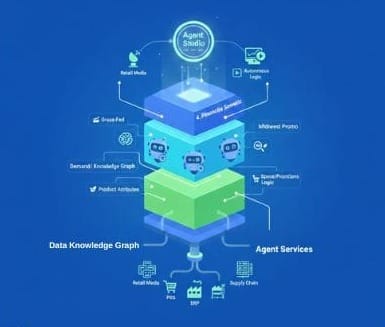
The era of manual data input and static insight decks is over. Traditional retail intelligence, with its horizontal silos, acts as a bottleneck. To thrive, leaders must abandon legacy methods and build a Vertical Intelligence Stack. Future spending must prioritize architecting the business rules that guide autonomous agents—like those in the Gemini/Walmart partnership—to select your brand by default.
Key Pillars of the Wave 3 Stack:
The Foundation: Transitioning from fragmented piles of data to a unified pipeline that integrates Supply Chain, Retail Media, and ERP into a real-time Reasoning Engine.
The Context: Moving beyond raw UPC codes toward a Retail Knowledge Graph—a universal translator that understands product value and offers logical substitutions without human intervention.
The Action: Empowering AI Agents to collapse the silos between Marketing and Supply Chain. This ensures your brand’s Trust Logic (quality, value, and availability) is the preferred choice for consumer assistants while automatically resolving fulfillment hurdles behind the scenes.
Conclusion: The Commercial Architect
While Wave 3 still centers on human strategy, automated systems must handle the heavy lifting. To avoid the "Dashboard Death Spiral," organizations must shift their hiring focus: hire Commercial Architects rather than Historians.
Lean businesses that establish these protocols today will not only survive the transition—they will secure their position as the preferred, trusted choice in an autonomous future.
READ FULL ARTICLE BELOW
The Stack: From Raw Data to Agentic Action
To succeed in Wave 3, CPG companies must fundamentally shift their perspective on data. Instead of treating data as static reports—the standard of the last twenty years—it must be viewed as a Vertical Intelligence Stack.
The traditional method was horizontal and siloed. Marketing, supply chain, and sales data existed in separate piles. To get anything done, a human had to manually grab pieces from each pile and glue them together into a report. The new goal is a unified engine where data flows upward, gaining intelligence at every level.
1. The Foundation: Unified Data Integration
It starts with the raw material. Instead of separate piles, you have a single pipeline that combines POS, social sentiment, weather, and inventory. Future-ready organizations integrate Retail Media, Consumer Data, Supply Chain, and ERP into a single, cohesive flow. This all-in approach is required to feed a reasoning engine, ensuring logistics decisions are informed by real-time consumer intent rather than last month’s receipts.
2. The Middle Context: The Processing Layer & Knowledge Graph
As data moves up the stack, it gains meaning. The system shouldn’t just see a UPC code; it should understand a "premium, grass-fed butter currently on promotion in the Midwest." This requires a Retail Knowledge Graph to act as a universal translator. Its job is to map every disparate ID (GTIN, UPC, SKU) to a single, global entity so AI Agents can identify the exact product regardless of the retailer's naming convention. This layer also manages substitution logic, allowing the system to instantly offer a logical alternative if a product is out of stock.
3. The Top Action: The Executive Layer & Agent Services
This is the vertical payoff. Because the foundation and middle are connected, the AI Agent moves beyond reporting and into Active Agency. This is where Marketing and Supply Chain finally collapse into a single, automated workflow.
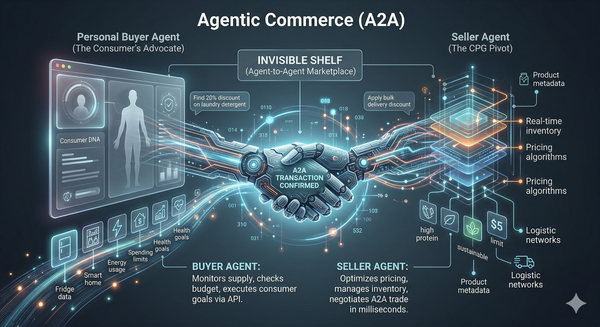
The Agentic Interface (Marketing as a Service): In partnerships like Gemini/Walmart, the agent uses your brand’s "Trust Logic" (nutritional standards, pricing, and stock status) to select your product. Marketing is now about having your brand's logic present and preferred in the agent's decision-making moment.
Specialized Agent Services (Supply Chain as a Service): Simultaneously, bots ensure the marketing promise is kept by verifying inventory and resolving fulfillment issues in real-time.
Semantic APIs & Agent Studios: This is the pinnacle. Through the Semantic API Layer, you no longer manage pixels or manual orders; you manage the Autonomous Logic that ensures your brand is the default choice for the consumer's delegated AI agent.
Why Small CPGs Should Skip the Dashboard Era
If you are building an Insights & Analytics (I&A) team today, avoid the "Legacy Trap" of 2024 best practices. In the old way, a week-old insight is a fossil.
Watch Out: The Dashboard Death Spiral
New teams often spend 18 months building Power BI dashboards that no one looks at, or they don't take the time to fully utilize the insights.
Future Proofing: Focus on Autonomous Action. Skip the dashboards and build Business Rules. If a supply disruption occurs, the system should automatically trigger price protection logic across all digital channels instantly.
Watch Out: Hiring Historians
Wave 2 teams explain the past through charts, requiring human analysts to bridge silos to tell a story.
Future Proofing: Don’t hire someone to tell you why sales were down in LA last week. Hire a Commercial Architect to build a Logic Engine that automatically adjusts digital coupons the second a competitor’s in-stock rate drops below 80%.
Watch Out: Syndicated Insight Decks
The industry relies on static, human-curated PowerPoint decks that summarize trends but cannot be executed by a machine.
Future Proofing: Treat data as an Executable Protocol. Instead of time-bound decks, invest in API-first data streams and a Command Center that make your product data Agent-Ready the moment a consumer's AI asks for a recommendation.
The Wave 3 Readiness & Capability Checklist
Evaluate your current I&A investment across these four layers. While Layers 1 and 2 are the required "Entry Stakes" for modern business, Layers 3 and 4 represent the shift into Wave 3. If your focus has been solely on the initial two layers, you have successfully created an advanced digital archive, but you have not yet developed an autonomous engine.
Layer 1: Data Integration (The Foundation)
[ ] Unified Streams: POS, Supply Chain, Retail Media, and ERP integrated into one source?
[ ] Real-Time Access: Data accessible via API, or trapped in manual downloads?
[ ] Granularity: Can you see Store/SKU/Day performance across all retailers?
Layer 2: The Knowledge Graph (The Intelligence)
[ ] Identity Reconciliation: System automatically links internal SKUs to every retailer’s unique ID?
[ ] Substitution Logic: Have you encoded substitution clusters for out-of-stock scenarios?
Layer 3: Agent Services (The Execution)
[ ] Demand Orchestration: Do bots monitor inventory and flag variances before they happen?
[ ] Automated Promotions: Are trade triggers based on real-time data or a static calendar?
Layer 4: Semantic API Layer (The Interface)
[ ] Machine-Readability: Is your product data agent-ready for AI reasoning?
[ ] Internal Agent Studio: Does your team have a sandbox to build new business rules?
The Future Reality: Managing the Logic, Not the Labor
Success in this new era requires a shift in how CPG leaders value their time. If your organization still spends the majority of its week manually cleaning data or building slides to explain the past, you are caught in a cycle that cannot keep up with a modern, autonomous market.
By building a vertical intelligence stack, you stop hiring people to move data and start building a team of Commercial Architects. These leaders oversee a system that standardizes and acts on information in real time.
In Wave 3, manual data prep is replaced by automated, live streams of value. The human relationship remains the anchor, but the busy work is handed off to the system. The goal of the modern account leader is to define the "rules of the game"—setting the strategy for how their brand should show up—while the technology ensures those rules are followed every second of every day.
Don’t build to play catch-up. Anchor your brand's unique value into this ecosystem today to ensure you are the trusted choice of the future.